Politics by Vishvanath, Cover Story
The fall of a left bastion: Kerala today, Sri Lanka next?
By Vishvanath
One of the many surprises in the recently concluded state elections in India was the collapse of the socialist rule in Kerala, and with that loss. India’s left has been left without control over any state for the first time in five decades.
The Left Democratic Front (LDF) of Chief Minister P. Vijayan was so formidable that its hold on power was thought to be permanent in Kerala. Some Indian political commentators have pointed out that the LF displayed a state capacity rare in Indian politics and tackled numerous issues efficiently and effectively, including natural disasters, economic slowdowns and the Covid-19 pandemic. It was also known for welfare delivery.
Kerala’s achievements under communist rule are numerous. It has one of the highest literacy rates in India, exceeding 95%, due to sustained public investment in school education, adult literacy campaigns and expansion of public institutions under successive leftist governments. It also boasts a robust public health system and impressive health indicators, such as a low infant mortality rate, a reasonably high life expectancy, and a well-established primary healthcare coverage. There have been pro-people land reforms which have benefited the ordinary people and weakened feudal structures. Poverty alleviation is also a success story in Kerala; poverty dropped from 60% in the 1970s to near zero during recent years. Kerala received international recognition for its model women-centred poverty alleviation programme. Welfare delivery was also quite satisfactory in Kerala, with the expansion of social security pensions, welfare schemes and food subsidies for vulnerable groups. Economic stability was notable in Kerala with sufficient investment in infrastructure, tourism and the knowledge economy.
The LDF governments had their fair share of critics, who were not happy with the manner in which issues such as unemployment were handled. It was also claimed in some quarters that Kerala lagged behind the other states which had achieved impressive progress in industrialization. The communist governments also faced allegations of various irregularities and corruption. A gold smuggling scandal, a controversial hydropower deal and an alleged bond scam stand out among them. But it is not these allegations per se that led to the collapse of the left rule in Kerala.
The factors that bring down governments are usually political, economic and moral, but some of them could also be psychological. As for strong governments, prolonged incumbency tends to result in complacency on the part of the rulers, institutional insulation and a lack of unresponsiveness, and, in most cases, tends to breed corruption and abuse of power. When political parties stay in power for extended periods, they become prone to internal rivalries, arising from competing ambitions and ideological differences among their key members. Such factors, even if managed, begin to tell on governments, making them institutionally weak. Voters are rarely satisfied with what they have, and it is also in human nature to take the existing state of affairs for granted and desire change, which has become a popular campaign theme across the world.
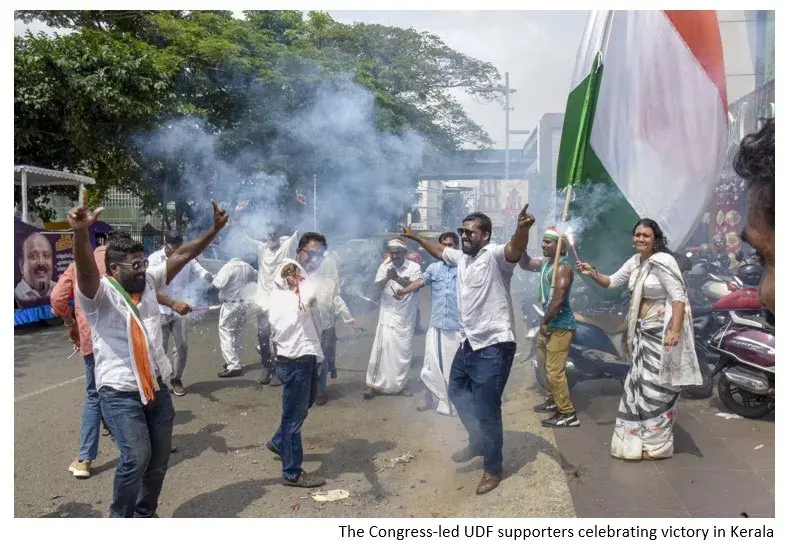
The Kerala voters have reposed their trust in the Congress-led United Democratic Front (UDF), and this is no mean achievement for the battered Congress and Rahul Gandhi, who has failed to turn his party and its allies into an effective countervailing force against the Modi juggernaut. But the challenge before the UDF is to match the delivery of the outgoing LDF. Voters naturally expect the UDF to outdo the LDF where delivery is concerned. It remains to be seen whether the Congress and its coalition partners will succeed in their endeavor. The possibility of the LDF recovering lost ground and making a comeback sooner than expected cannot be ruled out. Vijayan and the forces supporting him cannot be written off.
Interestingly, the fall of the left rule Kerala has come while a self-styled Marxist government is struggling to cope with a host of serious issues and on the defensive, in Sri Lanka.
The meteoric rise of the JVP-led NPP government in 2024 was hailed as a triumph of socialism. However, whether the incumbent administration is Marxist in the real sense of the term is a moot point, for it has abandoned socialist ideals for all intents and purposes. Its critics have pointed out that unlike in the past, it no longer displays the cutouts of Marx, Lenin and Engels at its May Day events and other key party events, and the economic policies it has adopted for political expediency are antithetical to the Marxist principles. It came to power, promising to renegotiate the IMF programme, which it said was disadvantageous to Sri Lanka, but reneged on its pledge.
Sri Lankans voted overwhelmingly for the JVP-led NPP, making its ascent to power possible not because they believed in the Marxist policies it flaunted or its leaders’ rhetoric but because they were fed up with the other political parties that had ruled the country since Independence. It benefited from a massive protest vote, following the country’s worst-ever economic crisis, and endeared itself to the public by making various promises, including tax and tariff cuts, economic relief, jobs, the restoration of the rule of law and the elimination of the culture of impunity, eradication of bribery and corruption, and a new Constitution to abolish the executive presidency. However, almost all these pledges remain unfulfilled, and those who promised to usher in good governance are now accused of various corruption scandals and subverting the legal and judicial processes.
Most of all, the radical departure from the rotten political culture has not yet materialized, and the JVP/NPP politicians are enjoying perks and privileges they said they would reject. It has resorted to methods such as increasing social welfare allowances and subsidies to boost its approval rating instead of concentrating on bringing about sweeping institutional reforms and leading by example. But the soaring cost of living, unfulfilled promises of relief and tax and tariff hikes, etc., have taken a heavy toll on the popularity of the JVP/NPP so much so that the government is wary of conducting the delayed Provincial Council (PC) elections, which will be an acid test for its popularity.
The SJB-led Opposition has not emerged strong, and is not likely to be able to turn the tables on the JVP/NPP any time soon. But in politics anything is possible. Even a minor electoral setback at the PC polls will be seen as the beginning of the end of the NPP rule.
RELATED NEWS
View all
Politics by Vishvanath
‘Cockroach’ uprising and echoes of Aragalaya
Jul 26, 2026
Politics by Vishvanath
Stage set for no-faith showdown
Jul 24, 2026
Politics by Vishvanath
Ranil looms in rearview mirrors of both govt. and Opp.
Jul 21, 2026
Politics by Vishvanath
Ranil’s comeback campaign gets underway in earnest
Jul 17, 2026