Cover Story
Beijing Summit – Trump Reports Trade Gains While China Claims Systemic Adjustments
By P.K.Balachandran
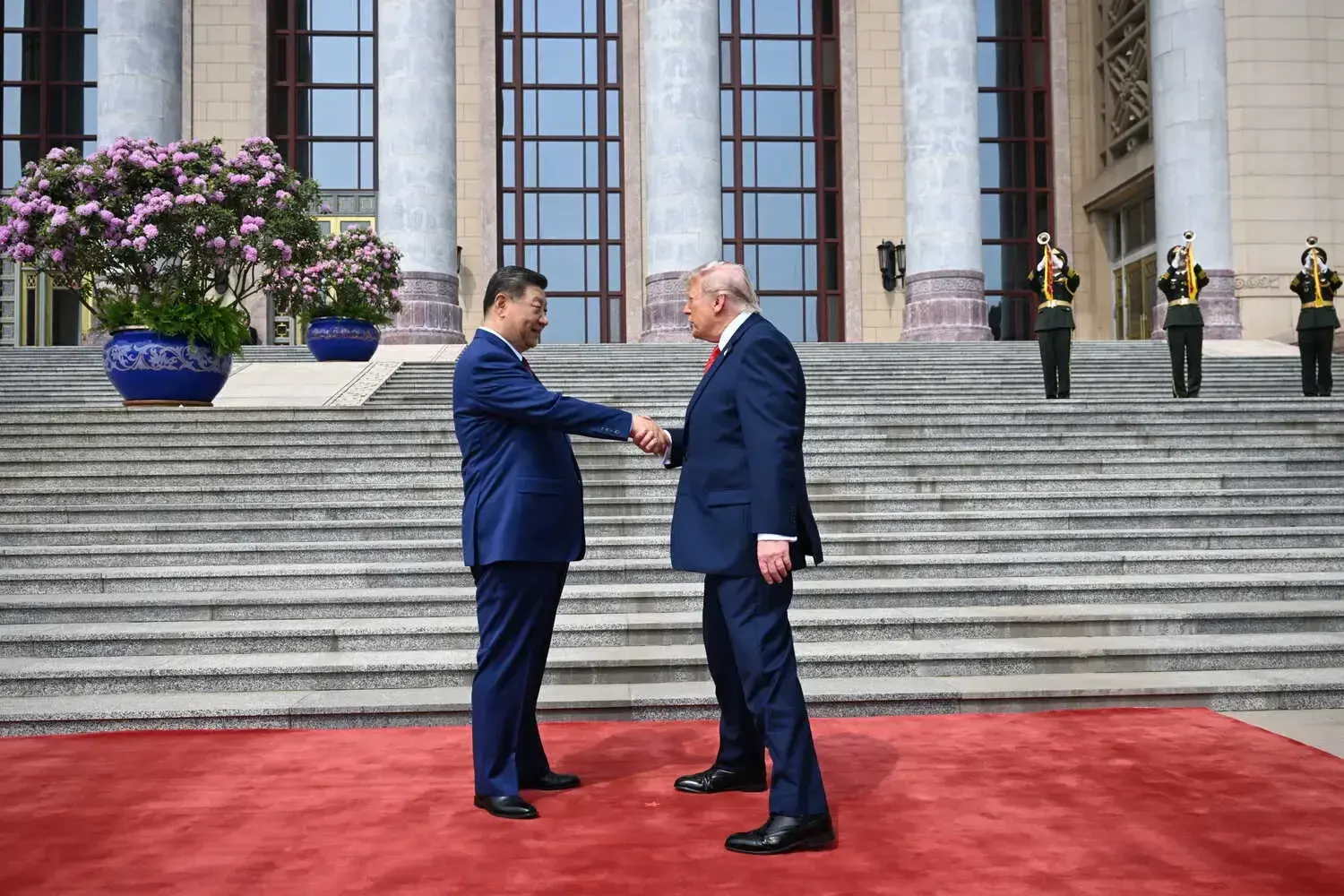
Colombo, May 15 - Both US President Donald Trump and Chinese President Xi Jinping, who met over May 14 and 15 in Beijing, came out of the parleys with a clear sense of achievement. While the Chinese Foreign Ministry reported a broad agreement to “promote the steady, sound and sustainable development of China-U.S. relations, and bring more peace, prosperity and progress to the world,” President Trump mentioned specific economic gains for the US in his interviews to the US media.
Xi and Trump, met twice on Thursday and discussed a range of bilateral and global issues and reached a series of new common understandings.
According to the Chinese Foreign Minister spokesman, the two leaders agreed on “a new vision of building a constructive China-US. relationship of strategic stability to provide strategic guidance for bilateral relations over the next three years and beyond.”
Trump Announces Specific Gains
But US President Donald Trump was more specific but all about America’s gains. He said he has secured “fantastic trade deals.”
“This has been an incredible visit. I think a lot of, a lot of good has come of it. We’ve made some fantastic trade deals, great for both countries,” Trump said on Friday at Zhongnanhai, the Chinese central leadership compound.
During the leaders’ meetings, Iran and the reopening of the Strait of Hormuz were discussed, Trump said. He also announced that Xi would visit the United States “on September 24, or thereabouts”.
“Like reciprocal trade, the visit will be reciprocal,” Trump said.
China has agreed to purchase as many as 200 Boeing jets, while Xi reportedly “likes the idea” of potentially buying US oil, Trump said in a Fox News interview on Thursday.
The US also expects China to buy “double-digit billions” worth of American agricultural products annually over the next three years, US Trade Representative Jamieson Greer said on Friday.
To institutionalise the new cooperative tone, the two countries were also discussing establishing a “board of trade” to manage commerce in “non-critical, non-strategic areas”, as well as a similar “board of investment” to steer outbound capital in those sectors, Treasury Secretary Scott Bessent said in an interview with CNBC on Thursday.
Trump also suggested a possible breakthrough for the financial services sector, regarding credit-card access being expanded in China.
“I said, ‘What about using Visa in China?’ For some reason, they were blackballed, and maybe that will come off,” Trump said during the Fox interview.
The two Presidents met for the first time in Busan last October, The current meeting is the second.
Details of the agreements reached are yet to be released,
At A Crossroads
The summit held in Beijing on May 14 and 15 took place when the US and China were at a crossroads. The two leaders were acutely aware that the path they chose would affect the economic and security situation worldwide, especially in West Asia and the Indo-Pacific.
The US entered the meeting as a weakened power due to its military and economic misadventures. It was waging a war against Iran, spending an estimated US$ 29 billion, but with nothing to report as a gain. It had antagonised most of the world by its sky-high tariffs and arm-twisting tactics using sanctions. It has been forcing countries to buy billons of dollars of American goods that they may not need.
On the contrary, China had retained its stature and strength by pursuing measured policies. Unlike Trump, Xi had not made any expensive military interventions abroad nor had he made diplomatic or trade moves to earn the displeasure or hostility of China’s trading partners.
Militarily battered in Iran and with a domestic economy marked by rising prices, Trump had little leverage to demand major concessions from Xi.
But Xi too was looking at the prospect of an economic decline if the Strait of Hormuz continued to be blockaded either by Iran or by the US. Forty percent of China’s energy needs are met via the Strait of Hormuz. Therefore, it is necessary to keep it open for navigation.
Despite the bluff and bluster on the media, both the US and China knew that they could not play a zero-sum game in which there would be only one winner who would take all. They needed each other to survive, and for that, they needed compromises or a “win-win” situation, as the Chinese would like to say.
When Xi and Trump met in Busan in 2025, the Chinese leader used his country’s control over critical minerals to nudge Trump to agree to a year-long trade truce. Now, Xi could use Trump’s poor performance in the Iran war to bring him a few notches down in terms of negotiating strength.
In fact, when Trump was getting battered in Iran, Xi enhanced his profile in West Asia by keeping up his chant on peace. He hosted foreign dignitaries from the Gulf and Europe to push for peace. The visitors included Iran’s Foreign Minister, Abbas Araghchi.
China had its own reasons to help end the Iran war. Its economy is affected by higher energy prices. A global recession will hurt China’s exports, which are a major engine of growth. Its strategic oil reserves, while helpful, are not limitless. In fact, China has gently prodded Iran to go for talks with the US.
In such an unfavourable scenario, Trump might have been eager to use Xi’s influence over Iran to bring the war to an end so that his face and money were saved.
China could work with the US to reopen the Strait of Hormuz without forcibly ending the blockade. 40% of its oil imports come via the Strait.
China could incentivise Iran’s moves towards a compromise on the Strait by offering loans, investments and offers to help with postwar reconstruction.
It is time Iran also realised that behind the excitement of war, Iran’s economy is in tatters. The reality is that a “patriotic war” could well turn into a “bloody internal strife” if the common man’s cup of woes overflows.
Taiwan
In return, Xi would have liked to extract a promise from the US not to go overboard in arming Taiwan, and increase the threshold of the threat to mainland China.
Xi could have sought a softening of US military support for Taiwan, either through a delay or reduction in arms sales to Taiwan or a statement that the US opposes its independence. The encouraging factor is that the Trump administration has already delayed announcing a US$ 13 billion arms sales package to Taiwan.
But this, if pursued seriously, could not be a happy augury for Taiwan, as President Ronald Reagan had assured Taiwan’s President in 1982 that the US would “not” consult Beijing before an arms sale to Taiwan. Trump’s deviating from this assurance would amount to a major departure from a long-standing American foreign policy stance.
During the Iran conflict, the US was forced to divert military assets away from Asia and deplete its munitions stockpiles. The conflict with Iran indicates that the US simply cannot sustain a major war with China over Taiwan.
Economic Deals
Both Trump and Xi desire to focus on keeping the economic relationship stable amidst the ongoing tensions. Trump has emphasized reciprocity and fairness in trade and China seeks predictability to support its economy.
The US has been pushing for a new formal mechanism—termed a “Board of Trade” comprising senior officials from both countries to oversee trade flows, monitor purchase commitments, and manage imbalances in a more structured way, shifting from ad-hoc tariffs towards a “managed trade”.
On its part, China has signalled interest in a parallel “Board of Investment” to address investment barriers.
China is widely expected to announce sizable purchases of US goods to demonstrate goodwill and help Trump show domestic economic wins, especially in agriculture, ahead of the November US midterm elections. The US wants China to buy Boeing aircraft, American soybeans and beef, and energy.
Rear Earths
Both sides want to extend the current agreement that allows rare earth minerals and magnets to flow from China to the US. China dominates the global refining of rare earths.
China dominates global production up to 60% in mining, 90% in processing/refining, and 94% of permanent magnets.
Recent Chinese restrictions have already disrupted US manufacturing and defence supply chains.
Discussions on technology export controls, AI competition, and market access to AI chips and investment in sensitive sectors are on-going.
“The Washington Post” expected the summit to focus on modest policy announcements and project an appearance of calm rather than grand bargains.
Basically, Trump needed tangible, headline-grabbing deliverables (purchases, oversight mechanisms) that could be presented as wins for US farmers, manufacturers, and energy producers. China aimed to buy time, stabilise its economy, and avoid further escalation.
END
RELATED NEWS
View all