Statecraft, Current Affairs, Counterpoint Political Desk
Trade unions girding up their loins for decisive battle
by Counterpoint Political Desk
President Anura Kumara Dissanayake threw down the gauntlet on Wednesday (25). He told state-sector trade unions on the warpath that no amount of shouting would compel his government to increase salaries. The protesting unions have decided to stage a countrywide strike on November 30.
In Sri Lanka, the beginning of a post-election period is usually characterized by an uneasy truce between trade unions and a newly elected government, especially when an unpopular regime is voted out and a new administration comes to power with a steamroller majority. Almost all trade unions are affiliated with political parties and help shape electoral outcomes. Most of them are therefore sympathetic to the new administration they help bring to power. However, this honeymoon does not last long if the new rulers fail to live up to workers’ expectations or antagonise them.
One may recall that the main leftist parties, the LSSP and the CP, which had a firm grip on the trade union movement decades ago, were constituents of the
SLFP-led United Front coalition voted into power in 1970. It was widely thought that the new government would be free of labour trouble. But bank workers resorted to industrial action two years later, and LSSP leader Dr. N. M. Perera himself chose to crush their strike, alienating the working class. After the 1977 regime change, which saw the decimation of the SLFP, the CP and the LSSP, there was a truce between trade unions and the UNP government with its five-sixths majority. However, trade unions went on the offensive in 1980, demanding a pay hike and prompting that administration to break their strike by sacking tens of thousands of strikers.
There were numerous labour struggles under subsequent governments led by both the SLFP and the UNP, with trade unions winning and losing their battles. In 2024, the JVP, with its vibrant trade union arm, came to power as the NPP coalition, raising workers’ expectations by promising pay hikes twice a year among other things. Trade unions apparently waited for two years, expecting the government to fulfil its promises. Budget 2027 came as a big disappointment to them, they say. The government insists that it has done everything possible to grant state employees the maximum relief it could through the Budget and will do its best to provide more in the next Budget, but trade unions are convinced otherwise.
It is never easy to satisfy the public through a Budget. N. M. Perera once quipped that Opposition MPs seemed to think the Finance Ministry had a money-printing machine. The Opposition promptly dubbed his Budget the “No Money (N. M.) Perera Budget”. Years later, Mangala Samaraweera said that, as Finance Minister, he lacked Harry Potter’s magic wand.
Trade union action intensifies
On November 23, unions representing Development Officers, Management Service Officers, health workers, technical officers, Samurdhi officers, teachers, principals and other public servants held protests demanding an interim allowance of Rs. 25,000 and solutions to longstanding salary anomalies. Doctors also staged a two-hour nationwide trade union action that day, withdrawing from routine duties while maintaining emergency services.
Teachers and principals are preparing for further action, including a sick-leave campaign on November 30 and a protest scheduled for December 1. Their demands include settlement of the outstanding salary anomaly, payment of a Rs. 25,000 interim allowance and improvements to other service-related benefits.
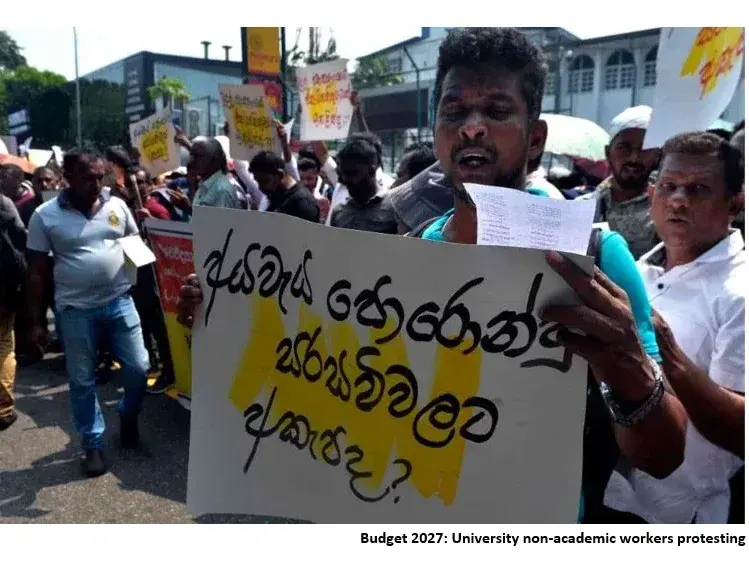
University non-academic employees have also continued token strikes and demonstrations, while dental surgeons have threatened industrial action over the proposed phased increase in the DAT (Disturbance, Availability and Transport) allowance. University teachers are also demanding relief.
The government is thus facing a growing challenge from sections of the public service which argue that economic recovery and improved fiscal performance have yet to translate into adequate relief for workers.
The Government Medical Officers’ Association (GMOA) has also decided to join the upcoming strike. Thus, several key state sectors, including education and health, will be affected by the planned industrial action unless the government manages to meet the demands of the warring unions or make peace with them. Coercive action will only aggravate the situation.
Show of strength in Parliament
The government's victory in the vote on the Second Reading of Budget 2027 has not eased pressure over its failure to provide what trade unions consider meaningful relief to public servants. The Committee Stage debate, which began on November 21, is continuing, with the final vote scheduled for December 14. Opposition parties have questioned the adequacy of salary increases, the distribution of tax burdens and the government's economic strategy, while the administration maintains that its Budget is designed to move the country from stabilisation to transformation.
The debate has also revived questions about Sri Lanka's economic direction beyond the IMF programme, which ends in March 2027. Conflicting remarks by government figures on whether the country intends to negotiate another programme have added uncertainty, although the government says it will continue engagement with the Fund. Inflation, fuel costs, household purchasing power and the adequacy of public investment remain central to the debate.
High-profile court cases
Meanwhile, several politically sensitive cases have made headlines during the week. Namal Rajapaksa remains entangled in the Krrish bribery investigation, with his bail suspended and a further court appearance scheduled for December 1. He is also facing proceedings over the SriLankan Airlines Airbus transaction, with the case scheduled for December 2. Former Minister Chamara Sampath Dassanayake was further remanded on November 27 in connection with the alleged Rs. 8.4
million bribery case involving phosphate exports and licences.
The Fort Magistrate's Court rejected former President Gotabaya Rajapaksa’s request to lift his overseas travel ban on November 25. Separately, he appeared to give evidence in proceedings relating to the disappearance of Lalith and Kugan, although reports differ on the status of the proceedings and the next date.
Yoshitha Rajapaksa and former Navy Commander Wasantha Karannagoda pleaded not guilty on November 23 to corruption charges linked to Yoshitha's admission to a British naval training course. Evidence recording commenced, with further proceedings fixed for December 10.
Former Minister Johnston Fernando was convicted on November 25 in a case involving an illegally assembled luxury vehicle, after pleading guilty to three charges under the Motor Traffic Act. He was fined Rs. 130,000 and given a suspended sentence.
The Court of Appeal on November 27 postponed until January 28, 2027, its decision on whether to grant leave to proceed with former state intelligence chief Suresh Sallay’s writ petition challenging his arrest and detention under the PTA in connection with the Easter Sunday attacks investigation.
Political tensions and controversial legislation
The controversy over proposed security legislation remains another flashpoint. Trade unions and political activists continue to oppose the proposed counterterrorism and prevention of organised crime laws, warning that they could give the authorities sweeping powers of arrest, detention and surveillance, undermine civil liberties and restrict the freedom to protest. The government rejects claims that the proposed legislation threatens trade unions or media freedom.
The Opposition is also continuing to raise questions over government accountability, the handling of corruption investigations and the independence of state institutions. These issues, coupled with mounting labour unrest, are adding to the political pressure on the administration as the Budget Committee Stage proceeds.
Cost of living and Champika’s math
The present government now faces a crisis of its own making, as its pre-election promises come back to haunt it: cheaper food, fuel at cost, a 33% cut in
electricity bills, no VAT on medicines and food, a Vitz car for Rs. 1.2 million, and stolen funds amounting to billions of US dollars recovered from Uganda.
Former Minister Patali Champika Ranawaka recently offered a data-based analysis. In Singapore, 92-octane petrol sells for the equivalent of Rs. 192 a litre, against Rs. 424 in Sri Lanka. For 95-octane, the figures are Rs. 244 and Rs. 490, respectively.
Since 2025, he says, 92-octane petrol has risen 41%, 95-octane petrol 43%, and kerosene, vital to poor farmers and fishermen, 54%, all weighed down by excessive taxes. He has challenged the government to disclose its fuel pricing formula immediately, accusing it of hoarding public money in the Treasury and deceiving the public by breaking its promises.
On electricity, he accused the government of throwing the country into disarray by raising bills by 8% to 47% rather than cutting them by 33%, as the President had pledged.
Celebration and commemoration
President Anura Dissanayake celebrated his birthday modestly, on Tuesday, receiving greetings from supporters nationwide. In the North and East, some people marked the occasion by cutting cakes in public.
On the 27th, commemorative events honouring war heroes were held across the North and East. In Nallur, Jaffna, a memorial for dead LTTE fighters was opened, with 67 structures commemorating 28,341 combatants killed in the war. Visitors offered flowers and lamps. The fighters were honoured as Maamanithar (great people) who sacrificed their lives for their nation, and a special archive includes a section, “Thuyilum Illam”, detailing their burial grounds.
Events were also held in Puthukkudiyiruppu, Kopay and Trincomalee. In Velvettithurai, Prabhakaran's birthplace, a cake-cutting ceremony marked his 72nd birth anniversary, with the local council's deputy chairman in attendance. The Tamil Guardian reported that two memorial halls had been built in those areas. Police, however, blocked commemorations at Nelliyadi and Chatti, ordering organisers at Nelliyadi to remove flags and seeking a court order to stop the event at Chatti.
These developments in the North and East are likely to be used by nationalistic forces among the Sinhala community against the NPP government,
and may even help catapult national security concerns to the centre stage of politics again.
Maname troupe visits Fifth Lane
At former President Ranil Wickremesinghe's invitation, the current Maname troupe visited his Fifth Lane residence on November 3, when the 70th anniversary of Maname, one of Sri Lanka's classic theatrical productions, fell. Wickremesinghe’s wife, Prof. Maithree Wickremesinghe, welcomed them warmly, and before leaving, the troupe, led by Mrs. Lalitha Sarachchandra, wife of the late Prof. Ediriweera Sarachchandra, who created Maname, sang several songs from the play.
Overall picture
The past week has seen the government consolidate its parliamentary position on Budget 2027 but struggle to contain discontent outside Parliament. The Budget debate is increasingly becoming a test of whether the NPP's claims of economic recovery can withstand demands for wage increases, better working conditions and meaningful cost-of-living relief.
Meanwhile, corruption investigations involving prominent political figures, disputes over security legislation and concerns over judicial independence continue to keep the political temperature high. The administration may have the numbers to push its Budget through, but the growing mobilisation of trade unions and unresolved public grievances could make the coming weeks considerably more difficult.
Share this story