Current Affairs
The 1948 UNSC resolution on Kashmir was in India’s favour
India should give up the stand that the resolution is outdated and that the Kashmir issue should be settled bilaterally.
By P.K.Balachandran
Colombo, September 25 - Any suggestion from any quarter that India and Pakistan should resolve their dispute over Kashmir on the basis of the UN Security Council (UNSC) Resolution of 1948, is now outrightly rejected by official and non-official circles in India.
India’s stand is that the Resolution is outdated and that the Kashmir issue should be settled through bilateral talks or even by war as some top ministers have been saying from time to time.
Countries which call for adherence to the UNSC Resolution are denounced as “anti-India.” The Turkish President Recep Tayyip Erdogan is the latest foreign leader to be so branded for using the podium of the UN General Assembly to say: “In South Asia, it is important that all disputes, including the Kashmir issue, be addressed through dialogue within the framework of the United Nations Charter and of relevant resolutions.”
India’s rejection is based on the wrong notion that going back to the Resolution will not be in India’s interest. But the fact is that the Resolution demands a lot from Pakistan and much less from India.
Though the public mood in Kashmir may not be congenial to India at present because of a series of unpopular steps taken by New Delhi in the last eight decades, it was very congenial in 1948-49 when a pro-Indian popular leader, Sheikh Abdullah, held sway over Kashmiri minds in 1948-49. India could well have secured a favourable verdict in the plebiscite or referendum mandated by the UNSC.
A careful reading of UNSC Resolution 47 of 1948 shows that it favoured the Indian position. The Resolution’s very first demand was that Pakistan should withdraw its invading forces from Kashmir. This has been the consistent Indian demand too.
India has never been averse to talks on Kashmir with Pakistan. But Pakistan has refused to withdraw its forces. The possibility of talks receded further in subsequent years as Pakistan kept sending terrorists across the border to strike sensitive locations in India, including Mumbai.
Had Pakistan implemented the first clause of Resolution 47, India would have been encouraged to implement its part of the bargain, namely, withdraw the bulk of its troops from Kashmir and hold a referendum (plebiscite) to determine whether Kashmir should join India or Pakistan.
The issue could have been settled by 1949–50, allowing both countries to live as good neighbours focused on development rather than preparing for war.
Events Leading to the Resolution
When the British Empire in India was dissolved on 14–15 August 1947, the territory was divided into two major units: a predominantly Muslim Pakistan and a predominantly Hindu India. The 561 princely States ruled by semi-autonomous indigenous rulers were given the option of joining either India or Pakistan (based on the religion of their populations and territorial contiguity) or becoming independent. Most States merged with India or Pakistan. Kashmir and Hyderabad, however, sought independence.
Pakistan expected Kashmir to accede to it because roughly 85 per cent of its population was Muslim. Its ruler, Maharaja Hari Singh, however, was a Hindu and preferred independence. But neither India nor Pakistan was willing to accept an independent Kashmir given its strategic location next to China and Central Asia (then part of the communist USSR).
The most popular Kashmiri political leader of the time, Sheikh Abdullah, preferred accession to secular India rather than Islamic Pakistan.
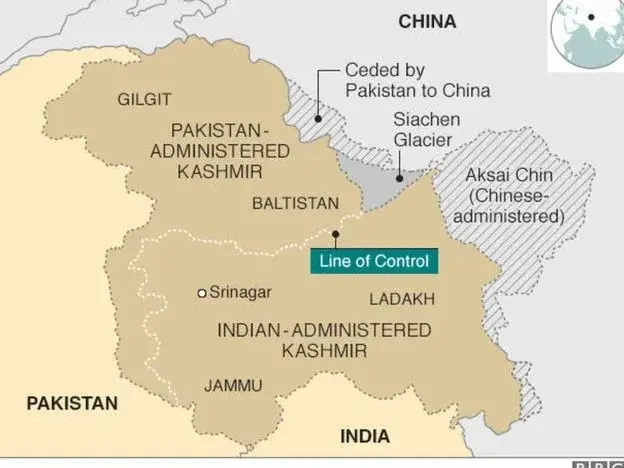
Pakistan then opted for coercion and sent armed tribal raiders into Kashmir to force the Maharaja’s hand. Hari Singh panicked, sought Indian military help, and signed the Instrument of Accession to India. Indian troops were flown in. The Indians pushed the raiders back to what is now known as Pakistan-occupied Kashmir or Azad Kashmir. As a result, Pakistan now holds a part of Kashmir and Gilgit-Baltistan in the North, while India holds Jammu, the Kashmir Valley, and Ladakh.
India Takes Dispute to UNSC
India took the dispute to the United Nations Security Council (UNSC) in January 1948. On 21 April 1948, the UNSC adopted Resolution 47. The Resolution noted with satisfaction that both India and Pakistan desired that the question of accession be decided by a free and impartial plebiscite. It called for an immediate ceasefire to create the conditions for that plebiscite.
Key Conditions of Resolution 47
Pakistan was to secure the withdrawal from Jammu and Kashmir of tribesmen and Pakistani nationals not normally resident there who had entered for the purpose of fighting, and to prevent any further intrusion or material aid to those fighting in the State.
Both countries were to make known that the measures provided full freedom to all subjects of the State, regardless of creed, caste or party, to express their views and vote on accession, and that they should cooperate in maintaining peace and order.
Once the United Nations Commission for India and Pakistan was satisfied that the tribesmen were withdrawing and fighting had ceased, India was to put into operation, in consultation with the Commission, a plan for withdrawing its own forces progressively to the minimum strength required to support the civil power in maintaining law and order.
India was to announce each stage of the withdrawal. The remaining forces were to be stationed so that they did not intimidate the inhabitants, with as few troops as possible in forward areas, and any reserves kept in their base areas.
Until the Plebiscite Administration assumed direction and supervision of the State forces and police, the remaining Indian troops were to be held in areas agreed with the Plebiscite Administrator.
Locally recruited personnel were to be used, as far as possible, for the re-establishment and maintenance of law and order, with due regard to the protection of minorities. If these forces proved inadequate, the Commission could, with the agreement of both governments, arrange for the use of forces of either Dominion.
India was to ensure that the Government of the State invited the major political groups to designate responsible representatives to share equitably and fully in the conduct of the administration at the ministerial level while the plebiscite was being prepared and carried out.
India was to establish a Plebiscite Administration to hold a plebiscite as soon as possible on the question of accession to India or Pakistan.
The State was to delegate to the Plebiscite Administration such powers as it considered necessary for a fair and impartial plebiscite, including, for that purpose only, direction and supervision of the State forces and police.
At the request of the Plebiscite Administration, India was to make available from its forces such assistance as the Administration required.
A nominee of the UN Secretary-General was to be appointed Plebiscite Administrator. Acting as an officer of the State of Jammu and Kashmir, he would have authority to nominate assistants, draft regulations, and communicate directly with the State government, the Commission, the Security Council, and the governments of India and Pakistan.
He was to bring to their notice any circumstances that might interfere with the freedom of the plebiscite.
India was to ensure that the State government appointed fully qualified persons nominated by the Administrator as special magistrates to hear cases bearing on the preparation and conduct of a free and impartial plebiscite.
India was to prevent, and give full support to the Administrator in preventing, any threat, coercion, intimidation, bribery or other undue influence on voters, and was to announce this undertaking as an international obligation binding on all public authorities in Jammu and Kashmir.
India was to declare, and ensure that the State government also declared, that all subjects of the State, regardless of creed, caste or party, would be safe and free in expressing their views and voting, and that there would be freedom of the press, speech, assembly and travel, including lawful entry and exit.
India was to ensure that the State government released all political prisoners and took all possible steps so that citizens who had left on account of disturbances were invited and free to return, that there was no victimisation, and that minorities in all parts of the State were accorded adequate protection.
The Commission was to certify at the end of the plebiscite whether it had been free and impartial. Both governments were invited to nominate representatives to assist the Commission. The Commission was also to establish observers as required.
The five members of the United Nations Commission for India and Pakistan were Czechoslovakia (nominated by India), Belgium and Colombia (appointed by the Council), Argentina (nominated by Pakistan), and the United States (designated by the President of the Council).
The resolution was adopted by 7 votes to none, with 4 abstentions (Belgium, Colombia, Ukrainian SSR, USSR).
An Assessment
It should be clear from the above account, that Resolution 47 of 1948 was largely in India’s favour. It required the prior withdrawal of Pakistani forces and left de facto control of the Kashmir administration with India, while still safeguarding the interests of Pakistan and the people of Jammu and Kashmir through the promise of a free plebiscite under international supervision.
Pakistan’s failure to withdraw its armed personnel, its subsequent consolidation of control over the territory it had seized, and India’s own lack of sustained commitment to the Resolution have together made the conflict interminable.
Had the first and decisive step—Pakistan’s withdrawal—been taken, the subsequent stages could have followed, and the Kashmir question might have been settled more than seven decades ago.
END
RELATED NEWS
View all
Current Affairs
Sri Lankan Presidential pardons- the good and the bad
Sep 11, 2026
Current Affairs
The pros and cons of joining BRICS- the dilemma of Pakistan and Bangladesh
Sep 09, 2026
Current Affairs
Disaster in Nepal gets embroiled in geopolitics.
Sep 08, 2026
Current Affairs
Why Mecca Pact, and what does it imply for its members, Israel and India?
Aug 18, 2026