Current Affairs
Revival of Hindu communalism in West Bengal after a 75-year hiatus
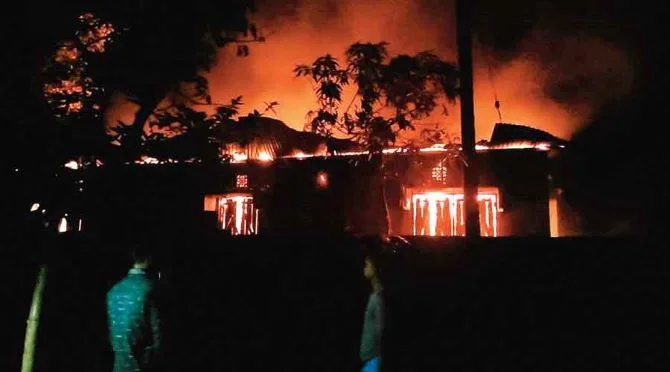
Hindu majoritarian communalism that was a major political force in Bengal prior to India’s independence, was marginalised by Congress and Communists regimes for 75 years. The 2026 State elections have brought it to centre stage.
By P.K.Balachandran
Colombo, May 8- The recent post-election violence in West Bengal was qualitatively different from that witnessed in the past. Earlier, clashes were between competing political parties with no religious overtones or undertones. But the recent clashes had a communal tinge.
The largely secular Trinamool Congress (TMC), which lost power on
May 4, is being attacked by the winner, the Hindu-nationalistic Bharatiya Janata Party (BJP), and vice versa. The underlying issue is, which ideology should prevail in West Bengal – whether it should be Hindu nationalism or a more secular ideology, devoid of a sharp Hindu-Muslim binary.
The victory of the BJP and the violence thereafter signal the revival of militant Hindu nationalism (now called Hindutva), an ideology of Hindu dominance, that was a major factor in undivided Bengal prior to India’s independence and its partition on Hindu-Muslim lines in 1947.
From 1947 to 2014, politics in India as a whole, was more or less secular. After 2014. when the BJP secured a firm footing at the allIndia level, the party had been eyeing West Bengal for conquest. West Bengal was seen as a prize as it had stubbornly refused to bend to Hindu nationalism even as most of the States surrounding it had turned saffron (the colour of Hindu nationalism).
Therefore, the May 4 victory of the BJP is a historical landmark for Hindu majoritarianism. But the TMC would not submit meekly. It is fighting back vigorously.
History of Communalism in Bengal
In pre-independence days, Bengal was a breeding ground for Hindu communalism. Joya Chatterji’s “Bengal Divided: Hindu Communalism and Partition, 1932-1947,” emphasises the important role of the “Bhadralok” (the Bengali Hindu gentry) in enabling India’s partition on Hindu-Muslim lines in 1947. According to Partha Ghosh, starting in the mid-1800s, a significant rise in Hindu nationalist consciousness emerged in Bengal – something not seen elsewhere in British India.
James Mill’s “The History of British India” had divided Indian history into Hindu, Muslim and British periods based on the dominant powers and their religious identities. The Bengali Bhadralok were quick to claim the “Hindu Golden Age” as their past. Writers like Bankim Chandra Chatterjee highlighted the era’s struggle against Muslims. British rule was undesirable but it was better than Muslim rule, it was argued.
Before becoming the focal point of the Indian national movement, Bengal started the Hindu Mela (gathering) in 1867. It was an annual gathering of Hindus that became popular across British India, says Sreya Sarkar, a public policy analyst based out of Boston in her piece in The Wire. The Hindu Mela was replicated in Lahore and Madras (now Chennai).
This inspired Sir Syed Ahmed Khan to initiate the Aligarh movement in 1875, in which he urged Muslims to pursue a Western-style education and acquire scientific knowledge while maintaining their Islamic values. In one of his speeches, Sir Syed said that the movement’s aim was to educate Muslims so that they could compete with the Hindus, especially Bengali Hindus who dominated the lower orders of the British Indian bureaucracy.
The frequent use of Hindu imagery in the Indian national movement, particularly the Swadeshi movement that started in 1905, upset the Muslims. In 1906, the All India Muslim League was founded in Dhaka to represent Muslim interests.
Noted Pakistani historian Ayesha Jalal pointed out how the ideas of both Muslim and Hindu nationalisms resulted from British social engineering, which began after the 1857 Sepoys Mutiny. The HinduMuslim cleavage came to the fore when the British conducted the census in the 1880s where emphasis was on the individual’s faith and caste, not so much on social economic status.
In Bengal, class conflict became intertwined with communal conflict. The 1932 Communal Award granted Muslims more seats than Hindus in Bengal’s legislature, reducing the Bhadralok to a minority in the assembly they expected to dominate. Muslims gradually gained ground in government jobs and educational institutions. The Hindu Bhadralok, who, as landlords, rent-receivers and professionals, held dominant positions in a predominantly Muslim peasant society particularly in East Bengal felt marginalized.
The Bhadralok then shifted from an inclusive anti-colonial nationalism to communal politics, driven by fear of losing their social, economic and political dominance. They redefined “Bengal” through a Hindu-centric perspective, cultivating a refined, elite form of communalism that significantly marginalized the Muslims.
Eventually in 1947, the Bhadralok used the Hindu Mahasabha and the Bengal Congress to mount a campaign to partition Bengal into a largely Hindu West Bengal and a largely Muslim East Bengal. The Partition plan helped the Bhadralok because hordes of Muslim poor and the middle class, fled to East Pakistan.
When the Left Front government took over West Bengal in 1977, it deliberately moved away from religion and other ascriptive identities. However, the Left failed to address the persistent discrimination against religious minorities, namely, Muslims. But the Left governments did control communal extremism for three decades.
The Trinamool Congress which took over after the defeat of the Leftists, used the Muslims as a vote bank without improving their lot, which according to the Sachar Commission’s Report, was worse than that of the Dalits, the lowest community in the Hindu socio-economic order. Instead of empowering Muslims with more jobs, better access to education or increased funding for entrepreneurial activities as recommended by the Sachar Commission, the TMC government chose to align with orthodox Bengali Muslims, giving monthly allowances to Muslim clerics.
However, the TMC’s approach fuelled the BJP’s propaganda that it was promoting Islamic fundamentalism. To counter the BJP, the government started giving allowances to Hindu priests and increased financial grants for Durga Puja committees. The BJP-TMC conflict was now firmly in the religious field.
But the BJP took time to exploit the latent Hindu nationalism among the Bengalis. But once the BJP started cultivating the Matua community which comprises Hindu refugees from Bangladesh, Hindutva’s appeal went up and the affiliation with the upper crust of Hindu society got diluted. The BJP’s presence in State politics grew.
The BJP started organizing Ram Navami and Hanuman Jayanti processions to rally Hindus. To stay competitive, TMC also included Ram Navami in its political strategy. Last year, the party declared a public holiday for the event – a first in Bengal’s history. The TMC government also allocated INR 250 crore from the State budget to build a replica of Odisha’s Jagannath Temple in Digha.
Rise of Islamic fundamentalism
Side by side with Hindu communalism, Muslim communalism also grew in West Bengal. Murshidabad district became known for Islamic radicalisation. Posters calling for the rebuilding of Babri Masjid in Agra that had been demolished by Hindu communalists in 1992, appeared in Murshidabad.
However, the new Muslim propaganda was running counter to traditional Bengali Islam which was a softer and syncretic Islam linked with Sufism and mystical traditions, blending core Islamic beliefs with local folk cultural practices, sometimes even incorporating elements from Hinduism. Sufi Islam venerates shrines for saints, which are taboo in Wahabi Islam promoted by rich West Asian countries and favoured by increasing number of Muslims.
West Bengal which borders Bangladesh bears deep scars of refugee influxes, demographic upheavals, illegal immigration from
Bangladesh and episodic violence. Traumas triggered by these factors are exploited for political manipulation by the BJP.
East Pakistan and Bangladeshi Factor
Even after the partition of Bengal on Hindu-Muslim lines in 1947, Muslim majority East Pakistan had 28% Hindus. But over the years, systematic, State-aided, persecution led to several waves for migration to India. The Hindu population in what is now Bangladesh, is just 3%. And they are still subjected to attacks and deprivation of properties in the rural areas. This creates tension in India, especially West Bengal and that is grist to the BJP’s communal mill.
With the BJP’s storming into power in West Bengal, Hindu-Muslim issues will be at the centre stage in the State’s politics, be a cause of violence in India and Bangladesh and of strained relations between the two countries..
As Seya Sarkar writes – “Competitive communalism in West Bengal has arisen as a powerful and disruptive political force, wherein two primary parties—TMC and BJP—- have strategically begun to exploit religious identities to garner votes. This perilous development shifts the political landscape towards divisive religious polarization, as both parties actively participate in aggressive identity politics that jeopardize social harmony and democratic integrity. “
END
RELATED NEWS
View all
Current Affairs
The place of workers’ remittances in the global and Sri Lanka context
Jun 15, 2026
Current Affairs
Roots of unrest in Pakistan-held Kashmir and Gilgit-Baltistan
Jun 14, 2026

Current Affairs
India gives up Car Nicobar airbase expansion on environmental grounds, but concerns remain.
Jun 13, 2026
Current Affairs
Sri Lanka’s joining the RCEP - opportunities and challenges
Jun 09, 2026